What an ODM Fragrance Project Costs, Line by Line
An ODM quotation is not a price for a smell. It is the sum of development hours, materials, tooling, testing, filling, packaging and documentation, and only some of those lines are visible when you compare two quotes. The brands that manage cost well are the ones that can tell which layer each number belongs to, because that is what makes two quotes comparable at all.
Key takeaways
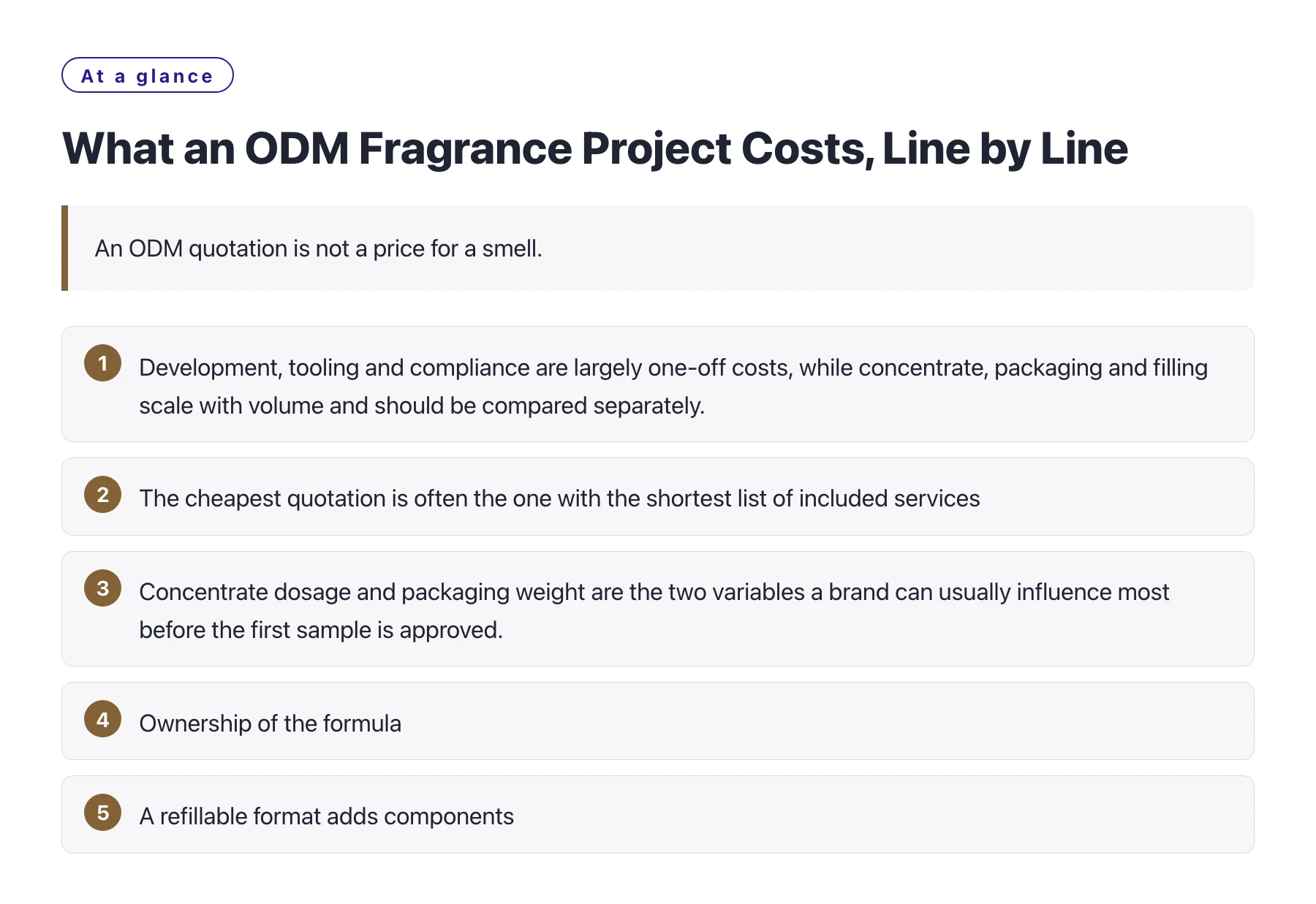
- Development, tooling and compliance are largely one-off costs, while concentrate, packaging and filling scale with volume and should be compared separately.
- The cheapest quotation is often the one with the shortest list of included services, so the missing lines matter more than the total.
- Concentrate dosage and packaging weight are the two variables a brand can usually influence most before the first sample is approved.
- Ownership of the formula, the mould and the design files is a cost question as well as a legal one, because rebuilding them later is expensive [3].
- A refillable format adds components, a second closure and extra assembly testing, which shows up in unit cost before it shows up in the retail price.
Most cost surprises in an ODM project come from comparing quotes that were never describing the same scope. One supplier prices development as a separate line and another hides it in the unit cost. One includes artwork adaptation and another does not. Sorting the layers before comparing numbers is the whole exercise.
The breakdown below follows the order in which money is actually committed, from the first laboratory trial to the last carton leaving the filling line.
Two kinds of cost, and why mixing them ruins the comparison
One-off costs are paid once and then sit in the project file: briefing and concept work, laboratory trials, stability and compatibility testing, tooling, and the documentation that travels with the product. Volume costs repeat with every unit: concentrate, bottle, pump, cap, carton, filling, assembly, decoration and packing.
Mixing the two produces the familiar situation where a supplier looks cheaper at 5,000 units and more expensive at 50,000. That is not dishonesty; it is a different split between fixed and variable. Ask for the two categories separately and the comparison becomes arithmetic instead of impression.
The layers, and what actually drives each one
| Cost layer | What pushes it up | What to compare between quotes |
|---|---|---|
| Brief and concept work | A vague brief, or one that changes direction mid-development | How many concept rounds are included, and what happens after them |
| Laboratory trials | Novel accords, restricted materials, unusual dosage | Cost per trial round and the number of rounds assumed |
| Application testing | New packaging, high alcohol levels, refill paths | Stability, compatibility and ageing scope, and who pays for failures |
| Tooling and moulds | Custom bottle shapes and custom closures | Who owns the tool, and what a second tool costs later |
| Documentation and compliance | Multiple destination markets, claims that need support | Which documents are included and which are billed separately |
| Concentrate and dosage | Higher concentration, expensive naturals | Dosage assumed in the quote, and the price per kilo at that dosage |
| Components and decoration | Heavy glass, metal parts, multiple print passes | Component sourcing, decoration passes and reject allowance |
| Filling, assembly and packing | Refill formats, multi-part assembly, hand finishing | Line set-up charges and minimum run length |
Two quotes can only be compared line by line if both answer the third column. A quotation that will not break the layers out is not a cheaper quotation; it is an unknown one.
The lines that tend to be missing
Quotations usually show what the supplier is selling and omit what the brand will have to buy elsewhere. Artwork adaptation, translation and market-specific labelling are frequent omissions, as are the tests a destination market may require beyond the supplier's standard panel.
Sample logistics are easy to overlook as well. Express shipping, duties and the cost of sending approved references back and forth can add up over a long development, and they are rarely itemised until they are invoiced. A quotation that will not break its layers out is worth reading again for where a perfume quote can hide costs, because the omissions usually sit in the categories the supplier did not name.
Compliance documentation is the omission with the longest tail. In the EU the framework places duties on the party that puts a cosmetic product on the market, including a safety assessment and a product information file [1], and third-party laboratories charge for the testing that supports those documents [2]. If the quotation does not say who prepares and pays for them, assume it is you.
Ask what a failed test costs
A protocol that fails halfway through development is a real budget event, not a technicality. Establish in advance who pays for the retest, whether the trial material is billed again, and how the schedule absorbs the delay. Suppliers who are confident in their process will answer this without hesitation, and their answer is informative either way.
Ownership is a line item too
The formula, the bottle mould and the design files have replacement costs. If the brand does not hold them, moving supplier later means paying to rebuild the product rather than transferring it. Industrial designs can be registered through national systems or the international route administered by WIPO, and registration is only useful if the brand rather than the supplier holds it [3].
A useful habit before any ODM deposit: write the quotation out again as two columns, one-off and per unit, and mark every cell that the supplier has not explicitly confirmed. The blank cells are the budget. Founders who do this once tend to do it on every project afterwards.
How a refillable format changes the arithmetic
A refill adds a second vessel, a second closure in many designs, and extra assembly and leak testing. All of that is volume cost, so it multiplies rather than sitting still. The compensation is that the primary bottle can be heavier and more durable, because it is bought once and refilled, which is where the format earns its positioning.
The refill also changes the concentrate calculation in a less obvious way. If the refill is poured or reseated, the liquid meets more air over its life, which pushes the development work towards stability rather than novelty. Development that has to solve a stability problem costs more than development that inherits a proven base, and the difference belongs in the one-off column.
Where the development sits inside a supplier that already runs Xuelei fragrance production on established bases, variation is cheaper because the starting point exists rather than being built from scratch. That is the structural advantage of ODM: the brand buys access to work that has already been paid for once.
It is worth understanding where a quotation can hide cost before comparing totals, because the same project can be presented as a low unit price with a large development fee or the reverse. The split matters more than the headline. A quote that hides a line is harder to argue with later than one that names it, and the comparison should always be between named lines.
What to do with the numbers once you have them
Rank the layers by how much control you have. Dosage, pack weight and decoration passes are usually changeable without redesigning anything, and each one moves the unit cost directly. Tooling and development are harder to renegotiate once committed, which is why they belong in the first conversation rather than the last.
Then set a contingency for the retest and delay events that a development programme tends to produce. A budget with no room for a second stability round is not a tight budget; it is a budget that will be exceeded.
The same discipline works when a supplier presents a single blended price. Go back to the cost drivers in custom fragrance wholesale question directly: which layers are inside this number, which are outside it, and what changes the per-unit figure at the volumes we actually expect to order.
Sources
- European Commission: Cosmetics in the EU —— The European Commission's overview of EU cosmetics rules, including the responsible person, product information file and safety report requirements.
- SGS: Cosmetics, Personal Care & Household Testing —— Testing, inspection and certification services for cosmetics and personal care, including microbiological, stability and safety testing aligned with cosmetics GMP.
- WIPO — World Intellectual Property Organization —— The UN agency for intellectual property; resources on industrial design and patent protection relevant to product and packaging design.
Frequently asked questions
Why do ODM quotes differ so much for the same brief?
Usually because they assume different scope: different numbers of trial rounds, different component sources, different documentation responsibility, and a different split between one-off and per-unit charges. Ask each supplier to answer the same line-by-line list before comparing totals.
Is ODM development cheaper than developing a formula independently?
For a first launch it usually is, because the brand buys into bases and formats the manufacturer has already developed. Over a long product life the comparison depends on volume, exclusivity and how much of the development cost would otherwise be amortised across other products.
What is the real cost of a refillable format?
A second vessel and often a second closure, extra assembly and additional leak testing, all of which are per-unit costs. Whether the format pays for itself depends on the retail price of the refill and how often customers actually buy one.
Should tooling be paid for separately?
It should at least be visible separately, so you can see who owns the mould and what a replacement costs. Tooling buried in the unit price is difficult to recover if the relationship ends.
How much contingency should a development budget carry?
Enough to cover at least one additional trial or testing round, plus the schedule cost of the delay. Projects that plan for a single attempt tend to be the ones that overrun most.